ST. JOHN BAPTIST SCALABRINI
All his life John Baptist Scalabrini was clear about his goal, heaven, and the way to get there, charity. A bishop, founder of two congregations, Scalabrini was first and foremost a man in love with God, capable of seeing in the least the gaze of Jesus.
His Life & Early Vocation
Born in Fino Mornasco, in the province of Como, on July 8, 1839, to a humble and religious family, he was the third of eight children. At age 18, in 1857, he entered the seminary and after six years was ordained a priest on May 30, 1863.
His desire was to go on a mission, but he was not granted: he began his apostolate as a teacher and then rector of the minor seminary in Como, a position he held until 1870. In the same year he was appointed pastor of St. Bartholomew Parish in Como.
Attentive to all social issues, he personally treated cholera patients in Portichetto, receiving a civilian medal for valor. In those years Scalabrini sensed the importance of religious education of the youngest: he wrote the Small Catechism for Kindergartens.
Deeply in love with God and extraordinarily devoted to the Eucharist, he was able to translate contemplation of God and his mystery into intense apostolic and missionary action, making himself all things to all people in order to proclaim the Gospel.
The Bishop of All

At the age of only 36, Pope Pius IX elected him bishop of Piacenza on December 13, 1875. He initially wanted to refuse the appointment, but, as he writes in his first pastoral letter, “with fear and trembling but resigned, I submitted to the ministry imposed on me”.
Scalabrini founded his 29-year-long ministry on two pillars: charity toward the most needy and spreading the faith through the teaching of Christian doctrine.
He was dedicated to the formation of clergy, whom he gathered and met with periodically, and young seminarians from the three diocesan seminaries. He wrote: “Considering that the holiness of the people depends on the holiness of the priests, I first willingly devoted my attention and care to my seminaries”.
“Preach the truth with charity”: to this motto he remained faithful throughout his episcopate. In 1876 he inaugurated the monthly magazine “The Catholic Catechist,” gaining 4,000 new catechists within three years, earning him the title Apostle of the Catechism from Pope Pius IX.
He celebrated three diocesan synods, consecrated 200 churches, sent sixty pastoral letters, and carried out pastoral visits to all 364 parishes in his diocese—reaching small mountain and hill towns on the back of a mule, while also visiting prisons and kindergartens.
I will not recuse myself from labors to make myself a father to the unfortunate, a tutor to the ignorant, a rector to the priests, a pastor to all, that made thus all to all, I may win all to Christ.
A Father for Migrants
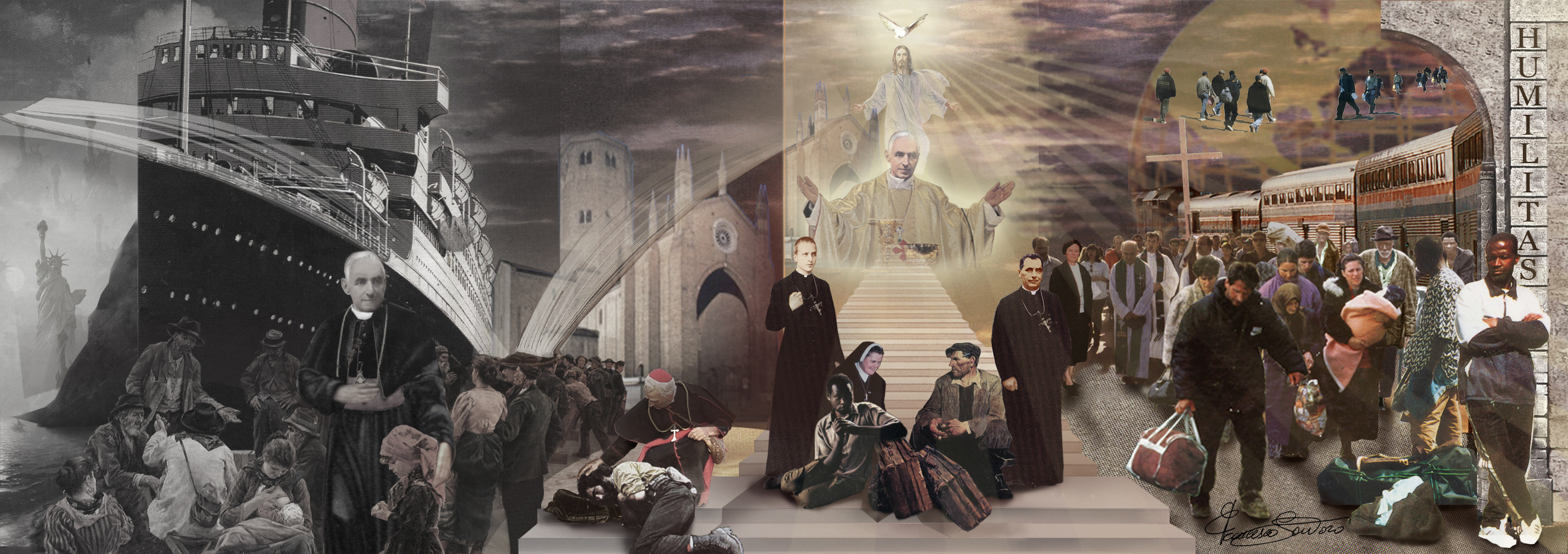
From 1875 to 1915 nearly 9 million Italians emigrated, heading first to Brazil and Argentina, then to the United States. Scalabrini studied the phenomenon and discovered that 12 percent of his parishioners were abroad. Uprooted from their cultural context, many Italian migrants lost their faith.
The step from compassion to action in Scalabrini’s soul is a short one: “I took up the cry of pain of our poor expatriates, and called the public’s attention to the nefarious work of human flesh traffickers”.
In 1887 he presented to the Sacred Congregation de Propaganda Fide the project of an association for the spiritual and material assistance of Italians abroad. Leo XIII approved the establishment of missionaries for immigrants, and on November 28, 1887, the Congregation of the Missionaries of St. Charles Borromeo was born in Piacenza. Scalabrini entrusted the mission to the protection of St. Charles, the bishop of Milan who risked his life for plague-stricken victims in 1576.
On July 12, 1888, the first ten missionaries left for Brazil and the United States. In 1889 he founded the St. Raphael Patronage Association for Emigrants, and established Emigration Committees in 19 Italian cities to support migrants at every stage: at ports, on ships, and during acclimatization.
Scalabrini often repeated: “The work of the Missionaries would be incomplete, especially in South America, without the help of the Sisters.” After encouraging St. Frances Xavier Cabrini to go to the Americas, he founded the Congregation of the Missionary Sisters of St. Charles Borromeo on October 25, 1895.
I myself more than once had to witness at the station in Piacenza the departure of emigrants, and I confess that, on seeing their misery and pain, at the thought of the very serious evils without number which they were going to meet, at the idea of the abandonment in which they would be left without any spiritual help, I felt my heart clench, and wept over their fate, and made a firm decision in my mind to try something.
A few days ago a young traveler brought me the greetings of several families from the mountains of Piacenza camping on the banks of the Orinoco River: Tell our bishop that we always remember his advice, that he should pray for us and send us a priest, because here we live and die like beasts… that greeting from the distant children sounded to me like a reproach.
Mission & Canonization
Scalabrini visited missionaries and migrants in the United States in 1901 and Brazil in 1904. He suggested to St. Pius X the establishment of a body at the Holy See for the care of all migrants, which resulted in the Special Office for Emigration (forerunner of today’s Pontifical Council for the Pastoral Care of Migrants and Itinerant People).
Returning from his last trip, he fell ill and died on June 1, 1905, the feast of Jesus’ Ascension. As Blessed Giuseppe Toniolo said of him, Scalabrini had “the intuition of events to come”. He was proclaimed blessed by Pope John Paul II on November 9, 1997, and on October 9, 2022, he was canonized as a Saint by Pope Francis in St. Peter’s Square.

Scalabrini looked beyond; he looked ahead toward a world and a Church without barriers, where no one is a stranger.
Prayer to Saint John Baptist Scalabrini
“O Saint John Baptist Scalabrini, Father of Migrants, you made yourself all things to all people to win all to Christ. Look with love upon migrants, refugees, and all displaced people throughout the world. Grant us your generous heart to welcome the stranger, protect the vulnerable, promote their dignity, and integrate them into one family of God.”