THE SCALABRINIANS
A comprehensive chronicle of faith, resilience, and unyielding service to migrants, refugees, and displaced communities across more than a century.
1. St. John Baptist Scalabrini — Bishop & Founder
St. John Baptist Scalabrini was born on July 8, 1839, in Fino Mornasco (Italy). He was ordained a priest in 1863 and became the Bishop of the Diocese of Piacenza at the young age of 37. He was a highly dynamic shepherd who visited every parish in his diocese, reformed catechism education, and paid special attention to the social and economic crises of his time.
Bishop Scalabrini was a visionary who saw that the Church needed to respond directly to the emerging challenges of modern society. He established schools, reformed clerical education, and spent nights writing pamphlets and addressing social problems that were tearing families apart.
During his 29 years as Bishop, he conducted five pastoral visitations of the entire diocese, visiting all 365 parishes, often traveling on foot or mule to reach the most remote mountain communities. He was an educator who founded the first national catechetical congress in Italy and established a specialized school for deaf-mutes. In 1887, he wrote a prophetic pamphlet titled L'Emigrazione Italiana in America (Italian Emigration to America), presenting a detailed analysis of the migration crisis and calling for legislation to protect migrants from exploitation.
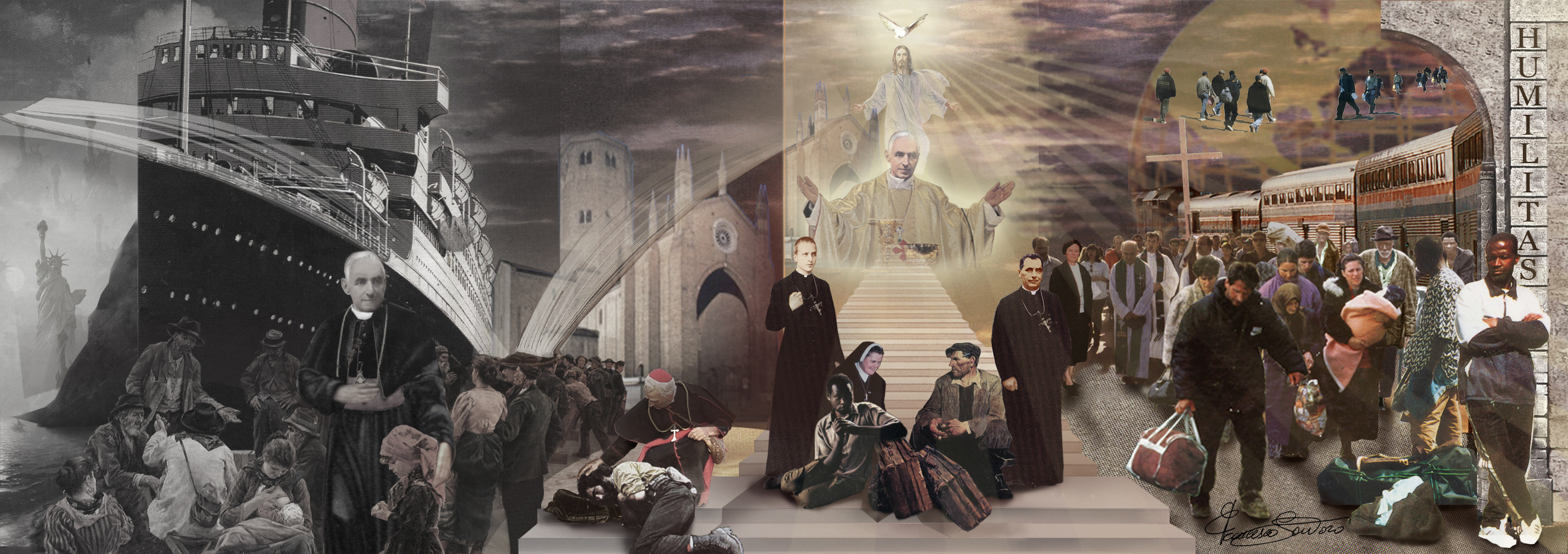
During a stop at the Milan railway station around 1881, he witnessed a heart-wrenching scene: hundreds of poor, ragged Italian emigrants waiting to board trains bound for ports, preparing to leave their homeland for the Americas in search of a livelihood. This event deeply moved his pastoral heart, creating what he described as a “knot in his heart” and inspiring him to dedicate his life to protecting and caring for both the spiritual and material needs of migrants.
2. The Foundation of the Scalabrinian Congregation

The Emigrant Crisis and the Call to Action
Witnessing the massive exodus of Italians to the Americas, Bishop Scalabrini recognized a tragic reality: these families were losing not only their material security but also their Catholic faith and human dignity in foreign lands. They had no priests who spoke their language, no social networks to defend them, and were often exploited by human traffickers.
To address this, Bishop Scalabrini petitioned Rome, wrote books, and delivered public lectures to wake up the conscience of the public and the Church hierarchy to the plight of migrants, proposing a structured, permanent religious response.
Under Bishop Scalabrini's guidance, the St. Raphael Society (Società San Raffaele) was founded in 1889. This lay association established a presence at major ports of departure (like Genoa) and ports of arrival (like New York and Santos, Brazil) to protect migrants from fraudulent agents, offer legal aid, and provide temporary housing.
November 28, 1887 – The Birth of the Congregation
Driven by intense prayer and pastoral urgency, Bishop Scalabrini officially founded the Congregation of the Missionaries of Saint Charles (Scalabrinians) through the papal brief Apostolici Muneris, issued by Pope Leo XIII. The new religious family was explicitly dedicated to providing spiritual care, educational support, and social advocacy for migrants across international borders.
“The migration of peoples is a phenomenon that touches millions. It demands a structured, holy response from the Church to protect both body and soul.”
In 1888, the first group of Scalabrinian missionaries set sail for the United States and Brazil, immediately establishing ethnic parishes, schools, and welcome centers to support families stepping onto foreign soil.
Realizing that the pastoral care of women and families required specialized care, Scalabrini also co-founded the Missionary Sisters of St. Charles Borromeo (Scalabrinian Sisters) in 1895, alongside Mother Assunta Marchetti and Father Joseph Marchetti. Later, the Secular Missionary Institute of the Scalabrinians was formed, completing the Scalabrinian family.
3. Migration Mission and Scalabrinian Charism
The Scalabrinian charism is deeply rooted in the Gospel message of welcoming the stranger. Recognizing the face of Jesus Christ in the migrant, the refugee, and the displaced person is the guiding force of all their missions.
“For the migrant, the homeland is the land that gives them bread and freedom. In Christ, there are no foreigners, only brothers and sisters.”
Beyond parish ministry, the Scalabrinians pioneered scientific research and social advocacy. They established the SIMN (Scalabrini International Migration Network) along with academic study centers in Rome, New York, Paris, and other cities to analyze migration trends and advocate for migrants' rights at international forums, including the United Nations.
Evolution of the Mission & Global Expansion to Asia
After World War II, the Scalabrinians expanded their mission to serve migrants of all nationalities, languages, and religions, transitioning from a focus on Italian emigrants to a universal mission for all displaced people. Recognizing the vast migration flows in Asia, the Scalabrinians arrived in the Philippines in 1982, establishing formation houses, parishes, and the Scalabrini Migration Center (SMC) in Manila. From there, the mission expanded to Taiwan, Japan, Indonesia, and Vietnam, establishing networks to support migrant workers, seafarers, and foreign students.
Stella Maris (Apostleship of the Sea): The Scalabrinians are heavily involved in the Apostleship of the Sea, ministering to seafarers, fishers, and port workers who face isolation and harsh working conditions at sea, ensuring they have access to spiritual and physical refuge.

4. Canonization and Legacy Today
“John Baptist Scalabrini was a bishop who was a father to migrants. He showed us that welcoming the stranger is an encounter with God himself, and is vital for the unity of the human family.”
On October 9, 2022, in St. Peter's Square (Rome), Pope Francis officially canonized Bishop John Baptist Scalabrini. Pope Francis chose to canonize him without requiring a second miracle (equipollent canonization), signaling the urgency and universal importance of Scalabrini’s message in today’s global migrant crisis.
Today, the Scalabrinians (including priests, missionary sisters, secular missionaries, and lay collaborators) actively operate in over 30 countries across all inhabited continents. They build cultural bridges, counter indifference and discrimination, and foster welcoming, inclusive communities in an increasingly mobile world.
